
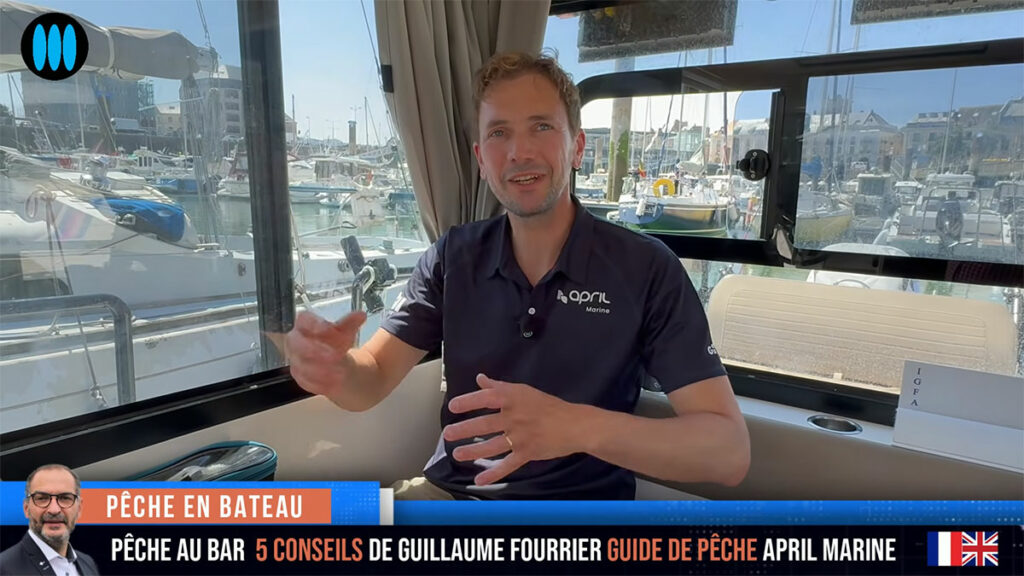
Where should you look for sea bass? When is the best time to fish, and which lures should you use? During a visit to Dieppe, ActuNautique met professional fishing guide Guillaume Fourrier aboard his boat to discover his best sea bass fishing techniques. Here are five essential tips to help you catch more sea bass, whether fishing from the shore or a boat.
During a visit to Dieppe, a journalist from ActuNautique asked Guillaume Fourrier five fundamental questions about catching sea bass. In a single interview, the professional fishing guide covered everything beginners need to know, from finding productive fishing spots to choosing the right lures and mastering their presentation.
Guillaume has been sharing his knowledge of sea fishing for more than 20 years. The author of 15 fishing books, he also writes every month for the French magazine Pêche en Mer, explaining and illustrating the rigs, techniques and lure presentations that help anglers improve their results.
Sea bass are among the most sought-after fish along European coastlines. Their strength, fighting ability and predatory behaviour make them particularly popular with anglers. Known as loup in the Mediterranean, European sea bass inhabit a wide range of environments, from shallow rocky shores to wrecks lying in several dozen metres of water. These opportunistic predators can hunt in just a few centimetres of water or patrol seabeds 50 metres deep. Their diet includes small fish and crustaceans, particularly sardines, anchovies, sandeels, crabs and shrimps.
Yet catching sea bass consistently can prove challenging. Some anglers spend countless hours fishing without regular success, despite using suitable equipment. The reason is simple: success depends primarily on understanding the fish’s behaviour. Anglers need to know where to find sea bass, identify their feeding periods and present suitable lures under the prevailing conditions. Sea bass are sometimes described as unpredictable or difficult to catch. Guillaume disagrees and explains why in this interview.
A year earlier, ActuNautique had tested Guillaume’s boat, a Dromeas 28 SUV fully equipped for sea fishing. During that trip, journalist Nicolas caught his first sea bass off Dieppe.
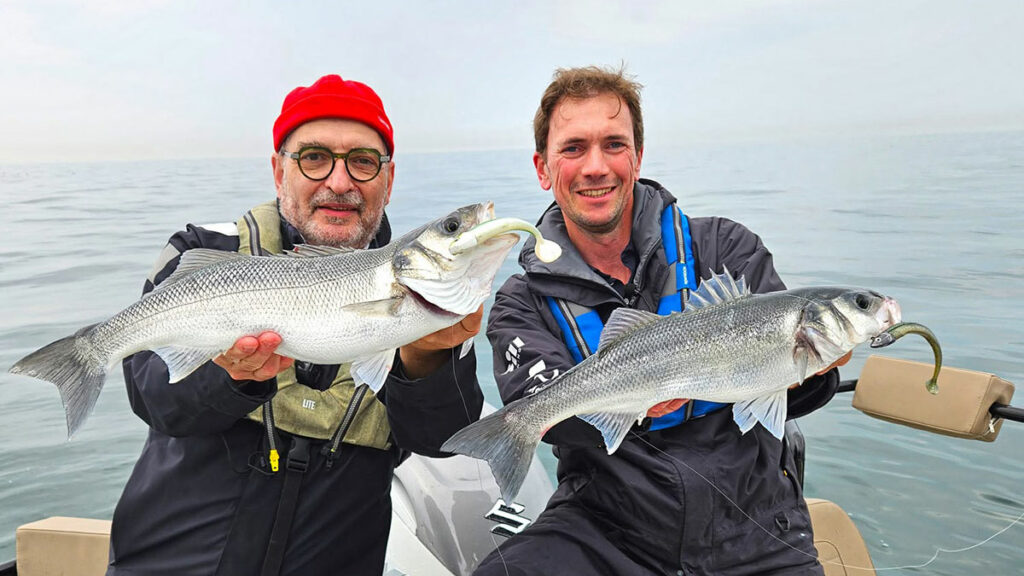
Following that experience, he decided to return and discover how anglers could catch sea bass independently, without relying on a professional guide.
1. Where to fish for sea bass: rocks, drop-offs and wrecks
Before choosing a lure or fishing technique, anglers must first locate the fish. Although this sounds obvious, finding productive fishing grounds remains one of the greatest challenges in sea bass fishing. Even the best rod and a perfectly executed lure presentation will achieve little if no sea bass are present. The first step is therefore to identify areas that concentrate prey and attract predators.
Shore fishing: focus on rocky ground
Sea bass are particularly attracted to rocky areas, which provide abundant food and numerous ambush points. Along tidal coastlines, the intertidal zone is especially interesting. Exposed at low tide, these rocky areas gradually become submerged as the tide rises. Rocks provide shelter for crabs, shrimps and many other small organisms that attract feeding sea bass once sufficient water covers the ground.
Crabs undergoing moulting are particularly vulnerable because their new shells remain soft. Sea bass readily move into shallow water to feed on these crustaceans, sometimes just a few metres from the shoreline. Long casts are therefore not always necessary to catch a good fish. Some sea bass hunt in water only 30 to 40 cm deep.
The boundaries between sandy and rocky ground also deserve particular attention. These areas often concentrate food and provide natural routes for travelling fish. They can be fished using soft plastic lures, hard lures or natural baits, particularly crab.
Boat fishing: explore underwater features
When fishing from a boat, the same principles apply. Nautical charts and fishfinders help identify rocky reefs, underwater plateaus, drop-offs, changes in seabed depth and wrecks. These features can concentrate prey and provide excellent hunting grounds for sea bass.
Drop-offs are particularly interesting. When tidal currents encounter a sudden change in seabed depth, they create turbulence and sometimes vertical water movements that can concentrate small organisms and baitfish. Sea bass take advantage of these conditions to intercept their prey. Larger specimens often adopt an ambush strategy, positioning themselves close to underwater structures rather than constantly chasing food.
Wrecks also provide productive fishing grounds in the English Channel and along the Atlantic coast. Their structures attract marine organisms, crustaceans and small fish, which in turn attract predators such as sea bass. However, not all wrecks are equally productive. Some regularly hold sea bass, while others are more frequently inhabited by pollack, poor cod or other species. Experience and careful observation with a fishfinder help anglers identify the most promising wrecks.
Guillaume Fourrier’s advice: Whether fishing from the shore or a boat, concentrate on rocky areas, changes in seabed composition and underwater structures that attract prey. Knowing where to fish is the first step towards success.
2. When is the best time to fish for sea bass? Understanding tidal currents
Finding a productive fishing spot is only part of the challenge. Anglers must also arrive when sea bass are actively feeding. Along tidal coastlines, currents strongly influence feeding behaviour. A fishing spot may remain quiet for several hours before suddenly producing multiple bites within a short period. These feeding windows can be brief, yet they may account for most of the fish caught during an entire session.
Changes in current can trigger feeding activity
Sea bass take advantage of moving water to capture their prey. As the current slows, small fish and crustaceans may leave their shelters to feed, making themselves more vulnerable to predators. When the current begins flowing again, these same prey species can become exposed to the moving water before returning to safety. Both situations create excellent feeding opportunities.
Throughout his fishing career, Guillaume Fourrier has observed that the final stages of a tidal current and the beginning of the next flow are often particularly productive. Feeding activity can become intense for just 30 to 45 minutes. This explains why two anglers fishing the same spot at different times may experience completely different results.
Beware: the current does not necessarily stop at high or low tide!
One of the most common mistakes anglers make is assuming that tidal currents stop precisely at high or low tide. In reality, the difference can reach two hours in some locations. For example, two hours after low tide, even though the water level has already started rising, the ebb current may still be flowing!
This phenomenon is partly explained by the inertia of moving water masses. When the sea reaches its lowest level, the current does not necessarily reverse immediately. It may continue flowing, gradually lose strength and eventually stop before changing direction.
Understanding this distinction is essential for successful sea bass fishing. Guillaume Fourrier pays particular attention to the 30 to 45 minutes before the current stops. As the flow weakens, shrimps and small fish begin leaving their shelters to feed. These prey become more vulnerable, and sea bass take advantage of the opportunity to hunt actively. Once the current stops completely, feeding activity often decreases considerably.
The same phenomenon occurs when the current starts flowing again. Small prey are still outside their shelters but begin to experience the force of the moving water. Sea bass exploit this new period of vulnerability to feed. The end of one tidal flow and the beginning of the next therefore provide two particularly favourable feeding windows, sometimes lasting only a few dozen minutes.
This does not mean sea bass stop feeding when currents become strong. They can hunt successfully in currents running at several knots. However, according to Guillaume’s experience, these transitional periods are particularly important. He plans his drifts to ensure that his boat is positioned over the most productive fishing grounds when these conditions occur.
The same observations apply to shore fishing. When fishing with four rods and natural baits, Guillaume has sometimes waited three hours without a single bite. Then, as the current begins to slow, two or three rods may suddenly register bites almost simultaneously. Sea bass weighing 4, 5 or even 6 kg can take advantage of these brief feeding opportunities.
3. What is the best lure for sea bass? A 12 cm shad
Choosing the right fishing lure can be confusing for beginners. Tackle shops offer hundreds of models, with countless shapes, sizes, colours and weights. Yet anglers do not need an enormous collection of lures to start catching sea bass. A few versatile models, used correctly, can cover a wide range of fishing situations.
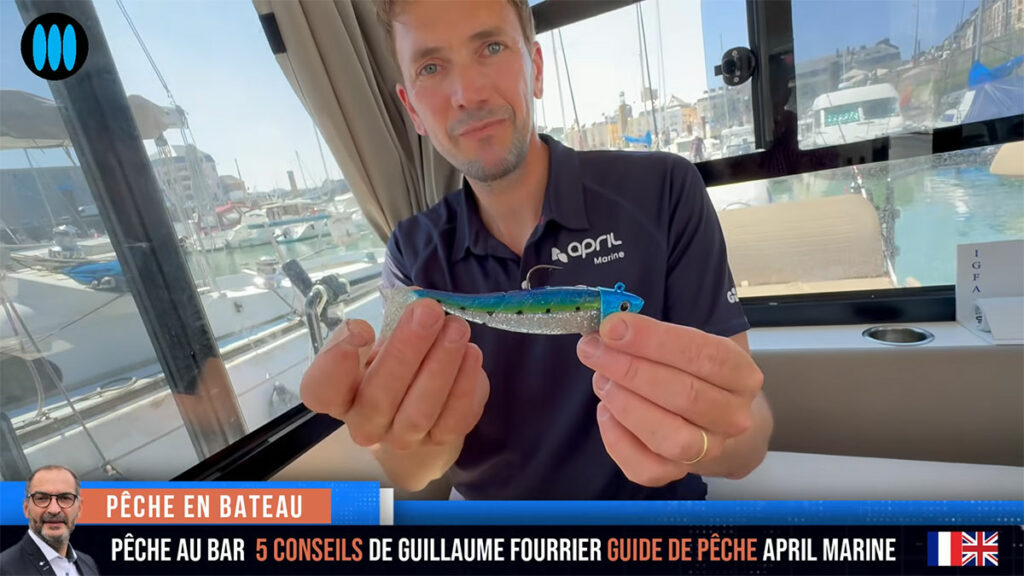
If Guillaume Fourrier had to choose just one soft plastic lure for sea bass fishing, he would select a 12 cm shad in a sardine colour pattern. This lure offers an excellent balance between attraction, versatility and ease of use. It can appeal to fish of different sizes and works well both from the shore and from a boat.
Why choose a 12 cm shad?
A shad features a relatively deep body and a paddle-shaped tail. During retrieval or descent, the paddle tail generates vibrations and causes the body to move, making the lure attractive to predatory fish. A length of 12 cm allows anglers to imitate many of the small fish eaten by sea bass, while the sardine colour pattern, with its silver and blue shades, resembles a common baitfish found along European coastlines.
During the interview, Guillaume presents a Kerfil Kerry Shad, although the same principles apply to other soft plastic lures with similar characteristics. The most important factor is choosing a lure that produces an attractive swimming action, even at relatively low speeds.
What jighead weight should you use for sea bass?
The appropriate jighead weight depends mainly on water depth, current strength and fishing conditions. From a boat, a 40 g jighead combined with a 12 cm shad provides a versatile starting point under the conditions discussed in the video. From the shore, a 15 to 20 g jighead may be more suitable when depth and current allow.
These weights are not universal. The objective is to use enough weight to reach the desired depth while maintaining a natural swimming action and good contact with the lure. A rig that is too light becomes difficult to control, while excessive weight may cause the lure to sink too quickly and reduce its effectiveness.
The quality of the rig also matters. The hook must have a sufficiently wide gape relative to the thickness of the lure’s body. If the hook point protrudes too little above the soft plastic, the lure may prevent the hook from penetrating properly during the strike. This detail can explain missed fish, particularly when sea bass bite cautiously.
Why glue your soft plastic lure to the jighead?
Guillaume Fourrier also highlights a small but important technical detail: securing the soft plastic lure to its jighead. When a lure is not properly attached, a missed strike can pull the soft plastic body away from the jighead. The lure then becomes distorted, affecting its swimming action and reducing its attractiveness.
A sea bass that misses its first attack may strike again if the lure continues swimming naturally. To prevent the soft plastic from slipping, Guillaume applies a small drop of cyanoacrylate glue, compatible with the lure material, between the jighead and the soft plastic body. He prefers small tubes, which are easier to store in tackle boxes.
Key point: A 12 cm sardine-coloured shad, correctly mounted on a suitable jighead, is an excellent starting point for anglers learning to catch sea bass with soft plastic lures.
4. How to choose the right lure colour, size and weight for sea bass
A sardine-coloured shad is versatile, but no single lure works in every situation. When sea bass are present but refuse to strike, anglers need to adapt their presentation. Continuing to use the same lure without considering what the fish are feeding on can mean missing valuable opportunities.
Match your lure to the available prey
Sea bass are opportunistic predators whose diet changes with the seasons, habitats and available food sources. They feed on sardines, anchovies, sandeels, small mackerel and horse mackerel, as well as gobies and other fish living close to rocky structures. Crustaceans, particularly crabs and shrimps, also form an important part of their diet.
These prey species have very different shapes and colours. A deep-bodied sardine-coloured shad does not necessarily resemble a sandeel, which has a much longer and slimmer body. Similarly, fish living close to rocky seabeds often have different colour patterns from those swimming in open water.
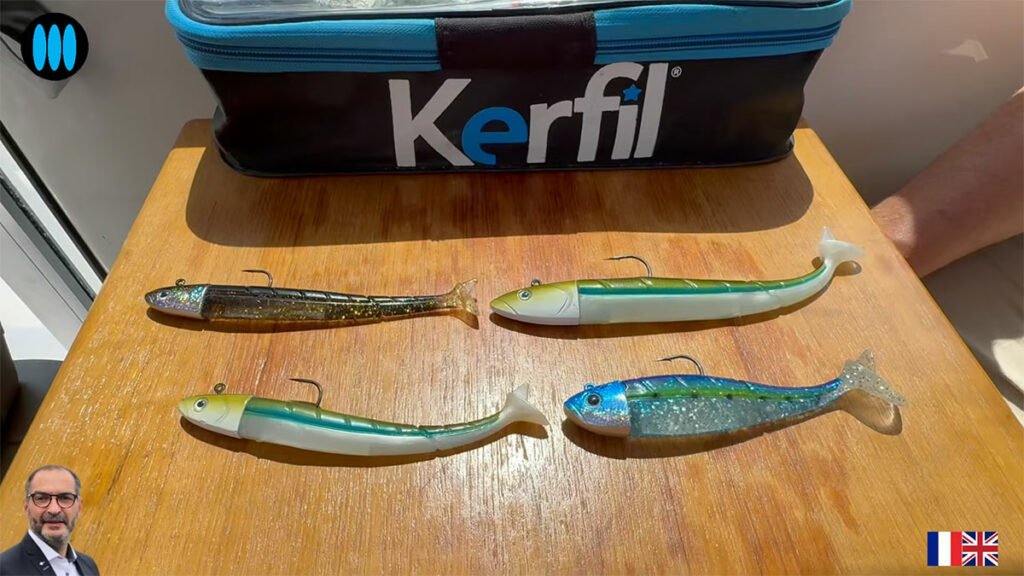
Imagine a shoal of sea bass actively feeding on anchovies. If an angler presents a lure that is too large or has a very different profile from the available prey, the fish may ignore it despite being actively feeding. In this situation, changing the lure’s colour, size or shape may be enough to trigger strikes.
Guillaume Fourrier therefore recommends carrying a small selection of complementary lures: a 12 cm sardine-coloured shad, a slimmer model resembling an anchovy, an elongated lure imitating a sandeel and a few alternative colours. The objective is not to accumulate unnecessary tackle but to have enough variety to adapt to changing conditions.
Light levels and water clarity also influence how fish perceive a lure. In clear water, natural colours often provide a realistic imitation of prey. When light levels decrease or the water becomes murky, stronger contrasts may sometimes prove effective. However, there is no universal rule, and observation and experimentation remain essential.
Adjust jighead weight to depth, current and boat drift
Lure weight must also be adapted to the fishing conditions. From a boat, deep water, strong tidal currents or rapid wind-driven drift can make lure presentation difficult. A lure that is too light may remain suspended for too long or drift too far away from the boat, making it difficult to maintain contact and identify its position near the seabed.
Under these conditions, Guillaume Fourrier regularly uses heavier lures, including 16 to 17 cm models fitted with 65 g jigheads. These rigs sink more quickly and transmit more information through the rod. They can also make learning easier for beginners, who find it simpler to detect the different stages of the presentation and contact with the seabed.
Contrary to a common assumption, the lightest lure is not always the most effective. The correct weight is the one that allows the lure to reach the fish and move naturally through the strike zone while remaining under control.
5. How to work a soft plastic lure for sea bass: mastering the descent
This is probably the most important technical advice in the entire interview. An angler may be fishing the right spot at the right time with an excellent lure, yet poor lure control can result in missed opportunities. When fishing vertically or drifting with soft plastics, sea bass frequently strike as the lure falls towards the seabed. This stage of the presentation therefore requires particular attention.
Why do sea bass strike on the drop?
When working a soft plastic lure close to the seabed, the aim is to imitate the movements of a small fish. A sharp lift of the rod raises the lure off the bottom. It then rises through the water before gliding back down towards the seabed.
During this descent, the shad’s paddle tail continues to vibrate while its body produces subtle movements. This action can resemble a vulnerable or disorientated baitfish, making the falling lure particularly attractive to hunting sea bass.
How to work a shad correctly
The first step is to let the lure sink until it reaches the seabed, allowing the angler to establish its position and depth. Once contact is made, a firm upward movement of the rod lifts the lure off the bottom. Guillaume Fourrier favours relatively sharp lifts, allowing the lure to rise quickly before making a longer, more natural descent.
The next stage is crucial. After lifting the lure, the angler must gradually lower the rod to follow its descent without restricting its movement. The lure should be allowed to glide naturally towards the seabed while maintaining light contact with the line. Completely slack braid can make bites difficult to detect, while excessive tension changes the lure’s trajectory and may affect its swimming action.
The challenge is therefore to find the right balance between freedom of movement and bite detection. A strike may produce nothing more than a faint tap through the rod, even when a large sea bass has taken the lure. The angler must remain alert and react quickly to set the hook.
Why do beginners miss so many bites?
When guiding anglers aboard his boat, Guillaume Fourrier regularly notices that beginners struggle to identify the exact moment a fish strikes. Some discover a sea bass on the end of their line after closing the reel’s bail arm, without having felt the bite during the initial descent. Others fail to detect strikes occurring between successive lifts of the lure.
Learning to fish effectively with soft plastics therefore involves developing sensitivity and understanding how the lure behaves underwater. With experience, anglers learn to distinguish contact with the seabed, vibrations from the lure, changes in line tension and genuine bites. Improving these skills can often turn a difficult fishing session into a successful one.
Guillaume’s advice: After each upward lift, follow the lure’s descent without slowing it excessively. Maintain light contact with the braided line and pay particular attention to subtle bites as the lure falls.
Successful sea bass fishing starts with understanding the fish
These five tips share one essential principle: successful sea bass fishing depends on much more than tackle. Anglers must understand where sea bass are likely to be found, identify their feeding periods, select suitable lures and master their presentation. Understanding the fish’s behaviour is the foundation of the entire approach.
Knowing productive fishing spots reduces wasted time. Understanding tidal currents helps anglers anticipate feeding opportunities, while accurate lure presentation improves their chances of converting bites into landed fish. Together, these skills explain why experience plays such an important role in sea bass fishing.
Nevertheless, fishing always retains an element of uncertainty, which is part of its appeal. A subtle bite might come from a one-kilogram fish or a magnificent sea bass weighing several kilograms. Until the fish appears beneath the surface, the outcome remains a surprise.
Sharing knowledge, passing on experience and enjoying time on the water are three essential values behind Guillaume Fourrier’s guided sea fishing trips in Dieppe, Normandy.